See it in action
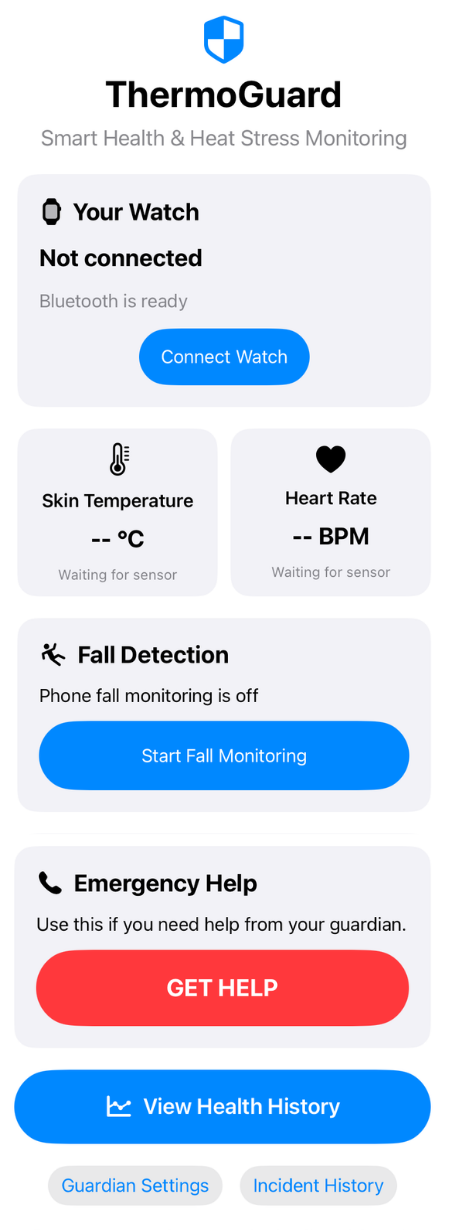
The real prototype, sending live skin-temperature and heart-rate readings to the ThermoGuard app.

ThermoGuard is a wearable smartwatch and iPhone app that helps people in the Blacktown area recognise heat-stress risk early and respond before it gets serious.
See how it worksHeat stress happens when the body gains heat faster than it can lose it. It is a real risk across the Blacktown Local Government Area, which regularly runs hotter than coastal Sydney.
Heat stress is when the body’s internal temperature rises above about 37°C, and sweating and skin blood flow can no longer keep up.
Above 40°C, cooling systems like sweating can stop working. This is a life-threatening emergency that needs immediate medical care.
Hot surfaces like concrete, asphalt and dark roofs trap heat, while tree cover and green space are uneven. This builds the urban heat island effect.
A low-cost wearable that measures skin temperature and heart rate, sends the readings to your iPhone over Bluetooth, and tells you how much risk you are at.
Below 34°C, or below 120 BPM
34°C or above and 120 BPM or above
36°C or above and 130 BPM or above
We also added a Sport Mode to cut down unnecessary notifications during exercise.
The real prototype, sending live skin-temperature and heart-rate readings to the ThermoGuard app.
From a fall-detection watch to a heat-stress monitor, with plenty of problem-solving along the way.
The brain. Reads the sensors, runs the heat-risk logic and sends data over Bluetooth.
Digital temperature sensor on the underside of the watch, measuring skin temperature.
Optical sensor that measures heart rate by detecting how skin changes with each pulse.
Rechargeable power so the watch works on its own.
We first built Fall Guardian in Xcode with SwiftUI to detect falls. We then redesigned it into ThermoGuard, adding temperature and heart-rate monitoring, risk levels, health history, guardian settings and an emergency help button.
We checked the watch’s readings against a trusted tool and watched how the app reacts as the numbers change.
We compared the watch’s skin temperature with an infrared thermometer gun, which measures surface temperature. The readings were usually within about 2°C of each other.
A thermometer gun reads the skin’s surface, so this checks our skin readings, not core body temperature. That is one reason ThermoGuard gives trend guidance and not a medical diagnosis.
Heat monitoring does not have to be expensive. Here is roughly what our prototype costs to build next to products you can buy today.
Skin temperature and heart rate, with Safe, Caution and Danger alerts on your phone.
A general-purpose smartwatch with heart-rate and many other features.
A specialist sensor that estimates core temperature and heat strain, aimed at athletes.
*ThermoGuard’s price covers the electronic components only. The cost of 3D printing the case varies. Other prices are approximate and checked in November 2026 (CORE’s US$285 list price is converted at about 1.43 AUD per USD); they differ between shops and change with sales. This is not a like-for-like comparison: the other products are fully engineered, tested and supported, while ThermoGuard is a student prototype and not a medical device.
Making personal heat monitoring more accessible, especially for older people, outdoor workers, athletes, students and anyone spending long periods in the heat.
Helps detect rising heat stress before it gets worse.
Built from low-cost parts so it can be used in real life.
Guardian alerts and location sharing help others step in when it matters.